Climate change
Climate change
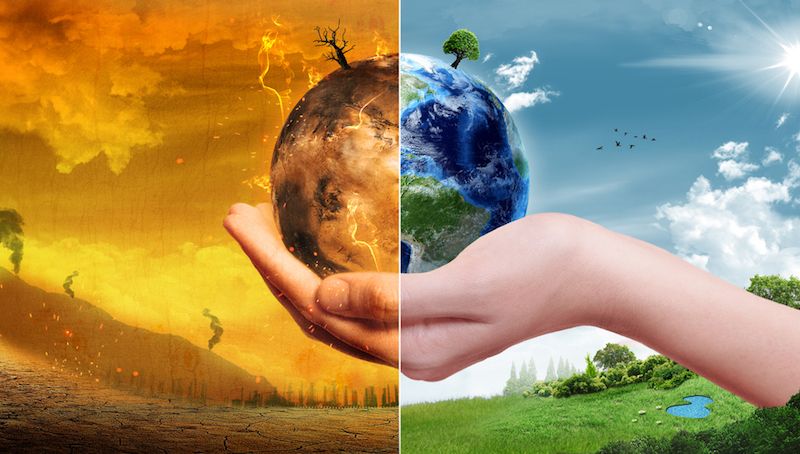
1. What do you already know about global environmental problems? Which of these problems do you think is the most serious today? Why?
2. Reading time.
Global consequences of the climate change
The 20th century was very notable with its unparalleled technological advancement of humanity. With each passing day the lasting impact that we leave on our planet becomes more and more apparent. The most obvious and harmful outcomes of heavy industrialization are global warming and climate change.
The first signs of global warming became obvious in the middle of the last century. Since the 1970s, the surface temperature of Earth has risen by 1 °C. Multiple data records show now that the warming happens at the rate of roughly 0.2 °C per one decade.
This is a very alarming development. The bulk of global warming is attributed to human activity. Assuming we don’t do something about it, the consequences would be lasting, probably irreversible, and very harsh.
The first and most obvious effect is the heating of Earth’s atmosphere. This means that there will be less cold days and more hot days overall. This in turn means that both plants and animals will need to adjust to it. Some of them might not survive such a change.
The secondary effect is the melting of continental ice, which makes sea levels rise far above their normal point. Extreme cases could lead to floods and destruction of continental coastlines.
Warmer weather also results in more water evaporating and the air becoming more humid. This can lead to even more rains, floods and some extreme weather patterns such as wildfires and tropical cyclones.
One of the most insidious and less obvious effects is the change of the oceans oxygen levels. Warmer water can hold less oxygen than the colder one, and so if the temperatures continue to rise, many underwater species risk total extinction.
While humanity definitely contributes much to climate change with irresponsible burning of fossil fuels, we still can battle it. Switching to renewable and clear energy sources, electrical cars, and improving the efficiency of our factories can curb the adverse effects we’ve inflicted on our planet over the last 100 years.
And if worse comes to worst, humanity can be very good at adapting to hostile environments10. Adaptation strategies include reinforcing the coastlines or relocating deeper into the mainland; development of weather-resistant crops; development of contingency11scenarios for local disaster management.
3. Check your understanding. Read the sentences and mark them as True (T), False (F), or Not Stated (NS).
1. The first signs of global warming became noticeable in the 1970s.
2. Since the 1970s, the Earth's surface temperature has risen by 0.2°C.
3. Most of global warming is caused by human activity.
4. All plants and animals will be able to survive the temperature change.
5. Melting of continental ice can cause floods and destruction of coastlines.
6. Warmer weather leads to less rain in tropical regions.
7. Colder water holds less oxygen than warmer water.
8. Switching to renewable energy sources can help fight climate change.
9. Humanity has already built weather-resistant crops in all countries.
10. The author believes that people can adapt to hostile environments if necessary.
4. Based on the text, explain what consequences of global warming threaten the planet. Write the consequence and its brief description (use the text).
5. What ways to prevent climate change are mentioned in the text? The text does not list all possible ways to fight climate change. Add at least three additional measures that you know (from lessons, news, books, etc.)
|

Комментарии
Отправить комментарий